March 2026 Newsletter
Global markets delivered another eventful month as US tariff rulings, strong corporate earnings and accelerating AI investment shaped sentiment. Locally, South African equities extended their rally, supported by commodity strength, while structural growth challenges remain firmly in focus. In this edition, we unpack global and domestic market trends, review the VEGA Global Strategic Fund, highlight Vertiv as our share of the month, and reflect on Morgan Housel’s insight that calm often plants the seeds of future instability.
Categories:
Date Posted:
March 3, 2026
Highlights of this month’s newsletter:
You can bomb the world into pieces, but you can’t bomb it into peace.”
– Michael Franti (Musician, 1966 – present, USA)
Market overview: performance figures (%)
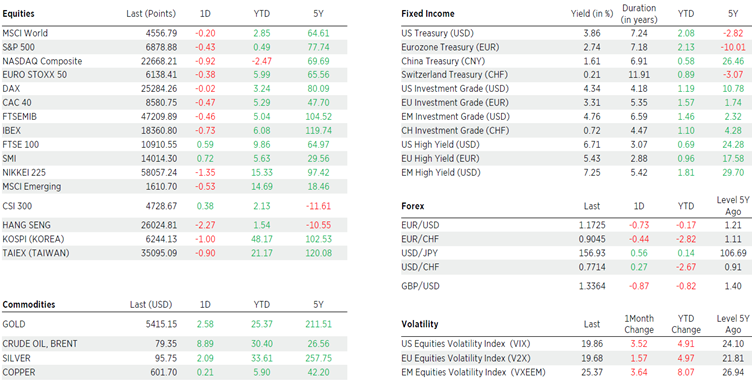
Source: Edmond de Rothschild, 28.02.2026
International market overview
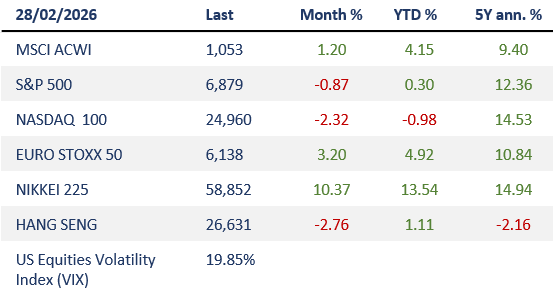
Source: Edmond de Rothschild
February turned out to be another eventful month. The US Supreme Court ruled against President Trump’s tariffs. This ruling overturns the tariffs initially justified by the fight against fentanyl trafficking, as well as reciprocal tariffs applied across the globe.
Nearly 80% of the S&P 500 companies reported earnings. The index’s earnings are on track to post year-over-year growth of 12%. Earnings momentum is still driven by the technology sector, although it is increasingly spreading to other, more cyclical sectors, such as industrials and materials. The technology sector delivered earnings growth of 26%, and the rest of the S&P 500 delivered only 6% earnings growth.
Below are some of the highlights:
Coca-Cola (KO)
Coca-Cola’s organic revenue rose 5% in 2025, driven by 4% growth in price/mix and a 1% volume increase. Adjusted operating profit grew 6.6%, as margins expanded 120 basis points to 31.2%, and adjusted earnings per share grew 4.2% to $3.00. Despite macro and geopolitical challenges, Coca-Cola managed to increase sales in line with its mid-single-digit long-term target, thanks to steadfast brand investments and its total beverage strategy. We expect zero-sugar soda offerings and functional drinks to be priorities in the coming years. Coca-Cola continues to demonstrate its offering with continues growth even in a difficult environment.
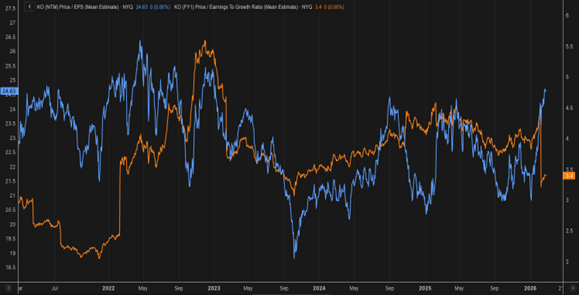
The company is trading at a forward price to earnings multiple of around 24 (blue line) and a PEG (Price to earnings/expected growth) ratio of 3 (orange line). This valuation is fair given its wide moat. The share remains one of our core holdings.
Chart 1: Forward price to earnings (blue) and PEG (Price to earnings/ growth) (orange) of Coca-Cola
Source: LSEG
Palo Alto Networks (PANW)
Palo Alto Networks reported strong second-quarter results, with sales growing 15% year over year to $2.6 billion and adjusted operating margins expanding 190 basis points to 30%. The firm’s next-generation annual recurring revenue grew 33%.
Palo Alto’s consolidation efforts within cybersecurity are clearly gaining traction. The firm’s multi-platform product lineup spans network, cloud, security operations, identity, artificial intelligence, and observability, and aligns well with customers seeking to consolidate spending with fewer vendors. The net retention for platformized customers was an impressive 119%. On AI, we are also seeing strong adoption of the firm’s AI-adjacent solutions; the customer count for XSIAM, the firm’s automated security operations solution, is up more than 200% year over year, and the number of runtime security customers is up more than 200% sequentially.
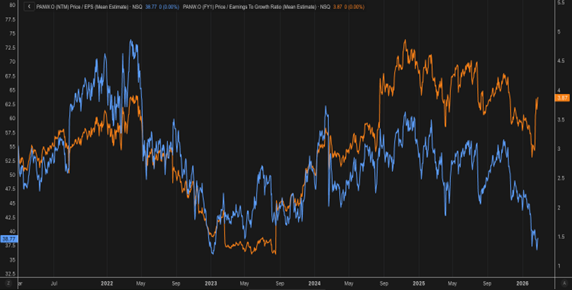
We see the recent selloff in Palo Alto shares as unwarranted and continue to view the firm and its security broadly as clear beneficiaries of AI. We think the market is inaccurately extending the competitive threat faced by SaaS companies in the application layer to security firms, which have higher switching costs, proprietary telemetry data, and a risk-reward profile skewed in a way to minimize churn. The company’s valuation multiple has decreased substantially and we see good value. The blue line in chart 2 shows the forward price to earnings ratio of the company. The ratio decreased from 60 to 38 during the previous 12 months.
Chart 2: Forward price to earnings (blue) and PEG (Price to earnings/ growth) (orange) of Palo Alto Networks
Source: LSEG
Alphabet (GOOGL)
Alphabet reported strong fourth-quarter earnings, with sales up 18% to $113 billion and adjusted operating margins down 50 basis points to 31.6%. Google Cloud continues to be the star of the show, accelerating both sequentially and year over year to 48% growth.
The massive surge in Alphabet’s share price has closely mirrored a turning tide, with investors now viewing the firm as an AI winner, with AI driving sales across the firm’s many segments. The most obvious beneficiary of AI within Alphabet remains its cloud business, which now constitutes 16% of the firm’s total top line. The launch of Gemini 3, Alphabet’s latest large language model, continued to expand the firm’s enterprise and consumer market share. We are impressed at how Alphabet continues to integrate AI within Google Search.
By adding features such as AI Overviews and AI Mode, the firm has not only mitigated a real competitive threat from GenAI chatbots but also increased the number of queries and the ad price per query. We continue to applaud Alphabet’s full-stack AI strategy, which enables the firm to be the master of its own destiny. Unlike peers that rely on external AI labs and AI chips, Alphabet’s investments in Google DeepMind and TPUs appear increasingly prescient over time.
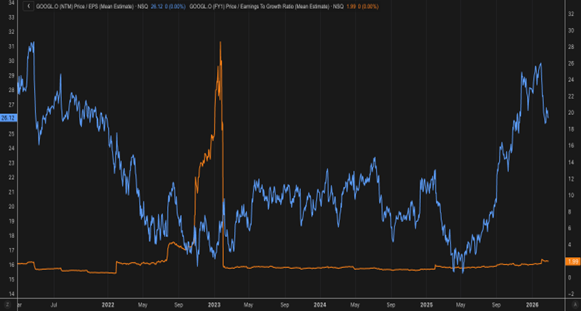
The main risk associated with owning Alphabet is the immense capital expenditure over the short term. Management guided to approximately $180 billion in capital expenditures in 2026, a 97% year-over-year increase, and 38% of our sales forecast for the year. Alphabet is one of our core holdings. We still have the view that the share is fairly valued trading at a forward price to earnings ratio of 26 (blue line) and a PEG ratio of 2 (orange line).
Chart 3: Forward price to earnings (blue) and PEG (Price to earnings/ growth) (orange) of Alphabet
Source: LSEG
Microsoft (MSFT)
Microsoft’s second-quarter results topped the high end of guidance. Revenue increased 15% year over year in constant currency to $81.3 billion, compared with the high end of guidance of $80.6 billion. The operating margin was 47.1%, compared with the high end of guidance at 45.8%.
Critically, we see strength in Azure in both traditional and artificial intelligence workloads. Near-term demand indicators are robust. Commercial bookings grew 228% year over year in constant currency, driven by large Azure deals, including the previously announced $250 billion OpenAI commitment.
We see results as consistent with our long-term thesis, which centers on the expansion of hybrid cloud environments, the proliferation of artificial intelligence, and Azure. We center our growth estimates around Azure, Microsoft 365 E5 migration, and traction with the Power Platform.
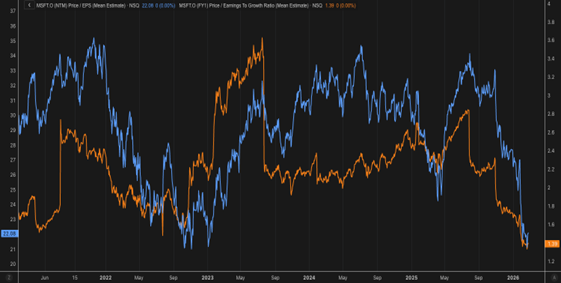
The share was punished along with the other software companies, but our view is that investors overreacted. Microsoft proved again that it will be very hard to replace and keeps on growing at a steady pace. Microsoft also remains a core holding for us. The valuation plummeted from 35 to 22 (blue line) in less than six months. We do not see this as a demanding valuation at all.
Chart 4: Forward price to earnings (blue) and PEG (Price to earnings/ growth) (orange) of Microsoft
Source: LSEG
Nvidia (NVDA)
Nvidia reported fiscal fourth-quarter revenue of $68.1 billion, up 73% year over year, up 20% sequentially, and ahead of guidance. Nvidia expects April-quarter revenue of $78.0 billion, which would be up 77% year over year. We see no signs of slippage at Nvidia, as revenue growth is accelerating from recent quarters, thanks to the massive growth in artificial intelligence capital expenditure announced by large cloud computing companies.
An “AI bubble” does not appear imminent. Supported by a strong fiscal first-quarter outlook, management suggested that its prior guidance of $300 billion of Blackwell and Rubin product revenue in calendar 2026 will be conservative. The forecast does not include any data center computing revenue sold into China, despite prior approvals of H200 sales. We still see solid upside potential as the share is not trading at demanding valuation levels.
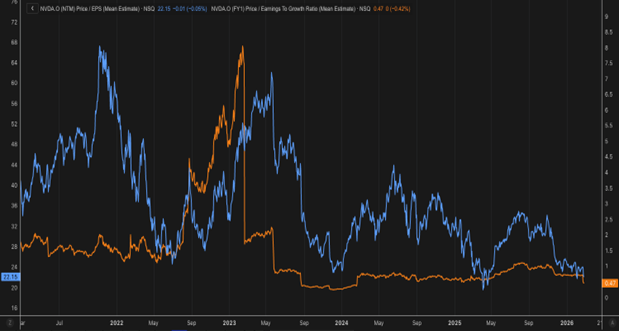
Nvidia trades at a forward price to earnings multiple of 22 (blue line) and a PEG ratio of 0.5 (orange line). There is a large risk premium baked into the valuation. The shares will remain one of our core holdings.
Chart 5: Forward price to earnings (blue) and PEG (Price to earnings/ growth) (orange) of Nvidia
Source: LSEG
Ferrari (RACE)
Ferrari reported very strong results. Shipments were down 0.8% year over year; however, net revenues increased 7%. This confirms the strong demand and brand Ferrari built over the years. Ferrari can easily increase prices and, in turn, increase revenue without having to increase production. We are positive on the long-term prospects of Ferrari. It is clear that the company has a strong advantage over other car manufacturers.
Ferrari’s valuation decreased meaningfully over the last year. The company currently trades at a forward price to earnings multiple of 33. We view this as cheap for a company of Ferrari’s quality. Ferrari remains on our buy list.
Summary
We are satisfied with our current portfolio holdings. Recent earnings reports have been robust, firmly validating our core investment theses. While short-term market volatility and negative investor sentiment have temporarily weighed on certain shares, this is an expected part of the market cycle. We remain fully confident in the underlying fundamentals and long-term performance of the companies we own.
South African market overview
Source: Moneyweb, SARB
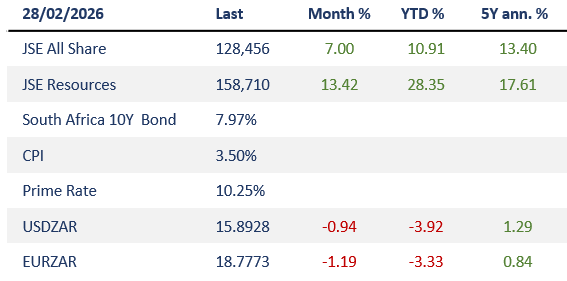
South African equities extended their strong run in February, with the JSE All-Share Index advancing 7% for the month. Once again, the strength in the local market was driven largely by commodity-linked shares, particularly resource counters that continue to benefit from firmer underlying commodity prices, resilient global demand, and a softer US dollar. That broader backdrop has remained supportive for South African miners, especially in precious metals, where higher gold and platinum-group metal prices have continued to lift earnings expectations and investor sentiment.
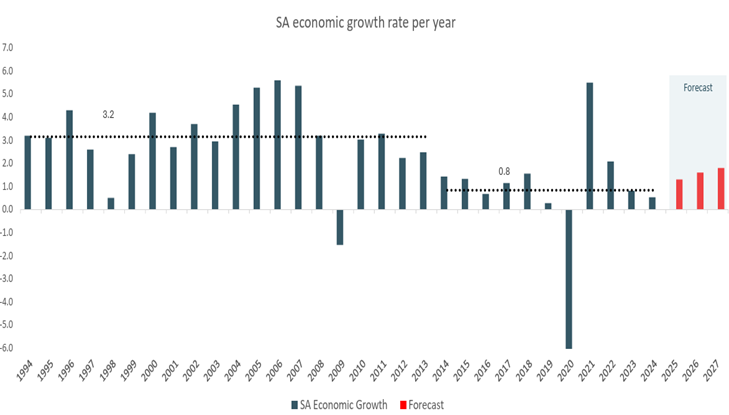
However, it is important to distinguish between a market benefiting from favourable external tailwinds and an economy that is experiencing genuine domestic improvement. Strip away stronger commodity prices and a weaker dollar, and South Africa’s underlying structural challenges remain firmly in place. The country’s long-term growth profile has weakened materially over the past decade, and that remains one of the most important constraints on the investment case. As our chart on South Africa’s growth slowdown and the need for reform highlights, the economy has shifted from a far stronger post-1994 growth trend to a much lower-growth environment in recent years. This slowdown reflects persistent structural constraints, including electricity shortages, logistics bottlenecks, weak private-sector investment, policy uncertainty, and poor public-sector efficiency. While markets can rally for a time on cyclical and external support, these deeper domestic constraints continue to limit South Africa’s long-term potential.
Chart 6: South Africa’s growth slowdown and the need for reform
Source: Granate Asset Management
This weak growth backdrop matters not only for economic activity but also for the fiscal outlook. With growth remaining subdued, the government’s ability to expand the tax base, reduce unemployment, and improve debt sustainability becomes far more constrained.
Treasury now expects gross debt-to-GDP to peak slightly higher in FY25/26 than previously forecast, largely because more bonds were issued in the current fiscal year than initially planned, both domestically and offshore, while the GDP denominator was also lower than expected. Importantly, cumulative bond issuance over the broader forecast period remains unchanged relative to the MTBPS, suggesting this is not a fundamental fiscal break from the past but rather a reminder of how difficult consolidation becomes when the economy remains stuck in a low-growth environment. In our view, this reinforces a simple point: without sustained structural reform and a meaningful recovery in growth, securing fiscal stability will remain difficult.
Against this backdrop, South Africa’s 2026 Budget was received more positively than in recent years. The government stepped back from R20 billion in previously planned tax increases while maintaining an emphasis on fiscal discipline, debt stabilisation, and expenditure control. Economists have broadly described the Budget as constructive and conservative, supportive of sentiment, but not transformative.
From a practical perspective, the Budget also introduced several notable threshold adjustments and tax changes. A number of monetary thresholds were increased broadly in line with inflation. These include the VAT registration threshold for compulsory registration, which rises from R1 million to R2.3 million, and the voluntary VAT registration threshold, which increases from R50 000 to R120 000 from 1 April 2026. The primary residence exclusion for capital gains tax increases from R2 million to R3 million, the annual tax-free investment limit rises from R36 000 to R46 000, the retirement deduction cap increases from R350 000 to R430 000, and the donations tax exemption for individuals increases from R100 000 to R150 000. In addition, the donations tax exemption for spouses will now be limited to donations made to a spouse who is a South African resident, effective 25 February 2026.
Further relief and reform measures were also announced. From 1 March 2026, taxpayers applying for voluntary disclosure relief may also apply for remission of interest, a welcome practical change. The single discretionary allowance for transferring funds offshore increases from R1 million to R2 million per calendar year, offering greater flexibility for individuals with international needs. On the revenue side, the government has proposed a 20% tax on gross online gambling revenue, with draft legislation expected in the upcoming budget cycle. Finally, crypto assets are set to be formally declared financial products, with crypto asset service providers becoming accountable institutions subject to supervision, reporting, registration, and enforcement requirements.
Overall, the market continues to respond positively to supportive global commodity dynamics, but South Africa’s deeper domestic challenges have not disappeared. The recent strength in the JSE is encouraging, yet it remains heavily influenced by factors outside the country’s direct control. Ultimately, stronger and more durable economic growth remains the key to improving the fiscal outlook, restoring business confidence, and building a more resilient long-term investment case for South Africa.
VEGA Global Strategic Fund Update
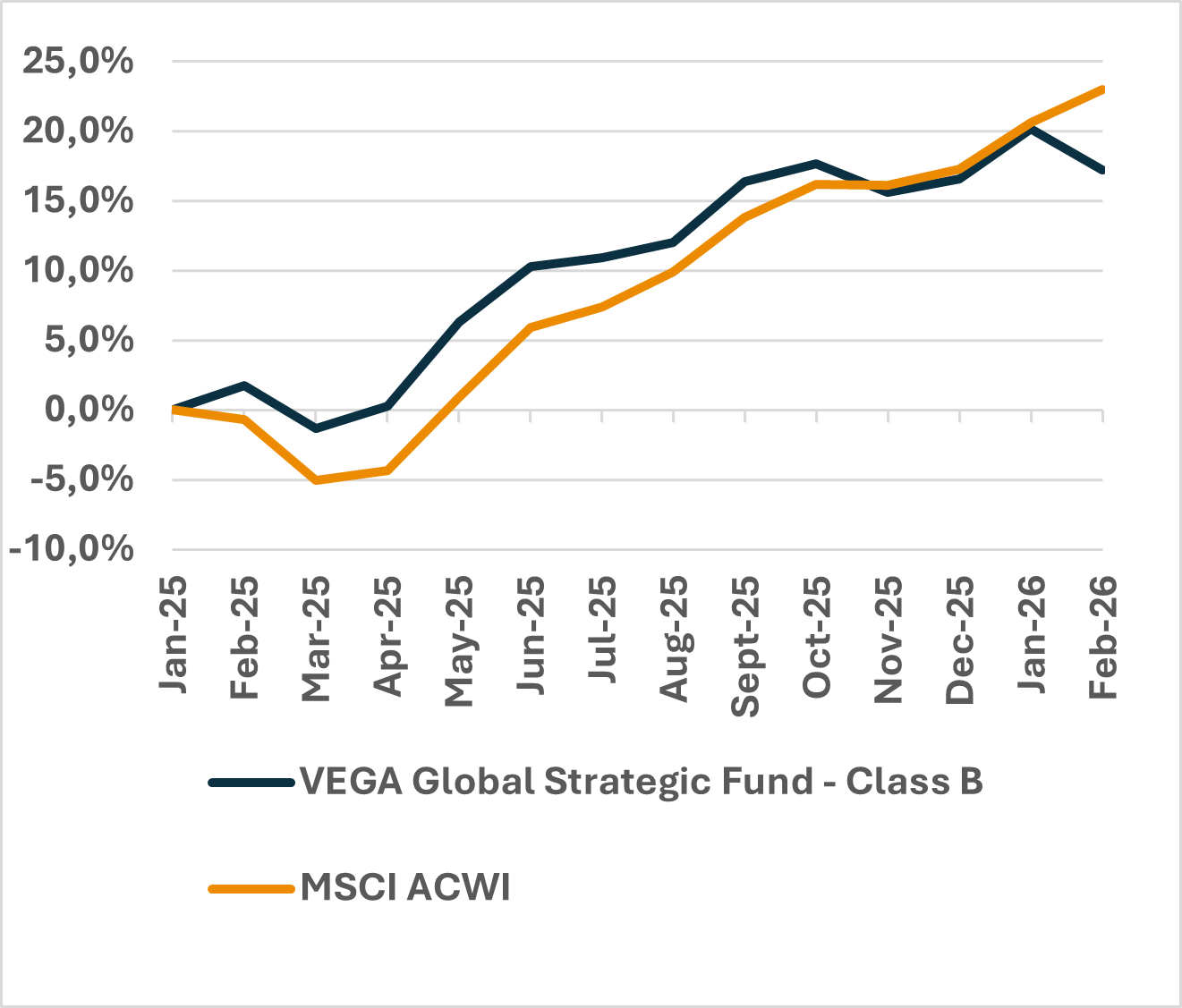
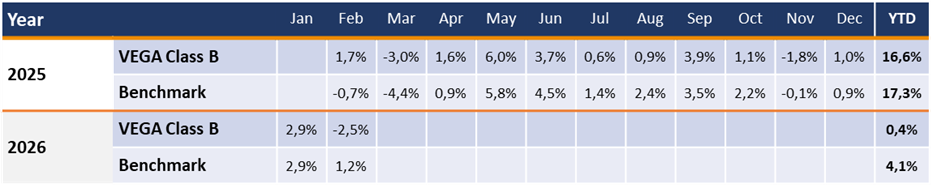
February was a more challenging month for the VEGA Global Strategic Fund. Over the month, the fund declined 2.5%, while the MSCI All Country World Index, our reference benchmark, gained 1.2% in USD terms. Despite the short-term setback, we remain focused on the long-term opportunities within the portfolio and committed to our investment approach.
Chart 8: Total return in USD since inception
Portfolio strategy
In the wake of heightened market volatility following President Trump’s tariff announcements, our stance has been to remain disciplined and avoid reactive portfolio shifts. History consistently shows that impulsive responses to short-term political noise often result in suboptimal investment outcomes.
Instead, we have used this environment to evaluate high-quality businesses that were indiscriminately sold off despite their strong long-term fundamentals. Periods of uncertainty can create attractive entry points into quality companies at compelling valuations, and we continue to focus on identifying these opportunities with a long-term perspective.
The portfolio remains invested in leading global businesses with durable competitive advantages, particularly those delivering high returns on capital and robust free cash flow generation. Dividend policies are not a central consideration in our selection process, as we generally favour companies that reinvest earnings to drive future growth.
We also resist the temptation to follow short-lived market trends or fashionable investment narratives, as preserving portfolio quality takes precedence over chasing momentum.
Changes which were made during the month
Erste Group Bank — Added position
We initiated a position in Erste Group Bank to gain exposure to high-quality Central and Eastern European banking operations. The bank’s strong capital position, improving profitability, and leverage to regional economic recovery underpin our constructive view.
Anglo American — Added position
We added Anglo American to increase exposure to diversified mining assets with long-term structural demand drivers. The company’s portfolio of copper, iron ore, and future-facing commodities positions it well to benefit from global electrification and infrastructure trends.
Glencore — Added position
We initiated a position in Glencore, attracted by its diversified commodity exposure and integrated trading business. The company’s cash flow generation and shareholder return framework support our investment case, particularly in a supportive commodity price environment.
Arista Networks — Added position
We added Arista Networks to strengthen our exposure to high-performance cloud networking infrastructure. The company continues to benefit from accelerating data centre demand and artificial intelligence-related capital expenditure, supporting a compelling long-term growth trajectory.
LVMH — Removed position
We exited our holding in LVMH following strong prior performance. While the company remains a high-quality luxury franchise, we saw more attractive risk-adjusted opportunities elsewhere in the portfolio.
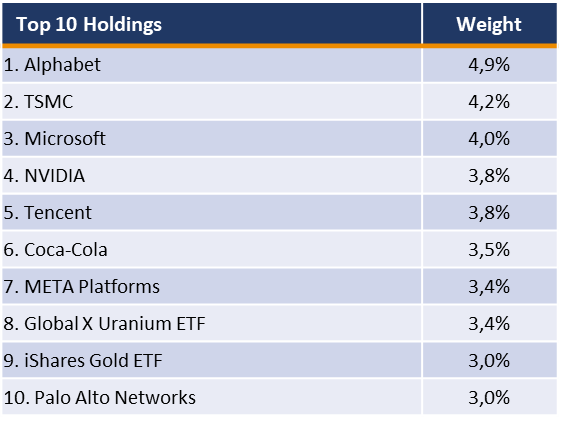
Top 10 Holdings
Monthly returns in USD net of fees
Share of the month: Vertiv
Vertiv is our top pick of the month because it gives us direct exposure to one of the most powerful themes in markets today: the buildout of AI-enabled data centres. More than 80% of Vertiv’s revenue comes from data centres, where it provides the thermal and power management equipment that keeps servers running safely and continuously. The company traces its roots back to the mid-1900s, was part of Emerson Electric before being acquired by Platinum Equity, and was listed on the NYSE in 2020. Its heritage in precision cooling for computer rooms dates back decades. In our view, Vertiv is now one of the cleanest “picks and shovels” plays on cloud, AI and digital infrastructure spending.
The core of the investment case lies in Vertiv’s position as a leading supplier of mission-critical equipment in data centres. Its flagship Liebert brand invented the first computer room air-conditioning (CRAC) unit in 1965, and today the firm offers a broad portfolio of cooling and power products: coolant distribution units (CDUs), CRACs, power distribution units (PDUs), uninterruptible power supplies (UPSs), racks, cabinets and full containment systems. These systems typically account for less than 10% of a data centre’s cost, but they are absolutely essential to uptime.
When your business depends on the servers in that room, you do not shop purely on price, you care about performance, reliability, and support. Vertiv’s equipment often remains in operation for 10–15 years, and some Liebert systems installed in the late 1970s are still running today. That track record has helped Vertiv build average customer relationships of more than 20 years, which we see as a strong indicator of a narrow economic moat based on brand, engineering know-how and switching costs.
Importantly, Vertiv is not just a box-seller. Around a quarter of its revenue comes from aftermarket services and spares, supported by a global cohort of highly skilled field engineers who work directly on customer sites. These teams handle training, testing, inspection, design support, maintenance and remote monitoring. Once Vertiv’s systems are specified in a facility, they are serviced by Vertiv engineers over their useful life, and at replacement time, they are typically swapped like-for-like because electrical and thermal systems are carefully engineered as an integrated whole. As Vertiv’s product set becomes more technically complex, particularly as AI workloads increase power density and cooling requirements, the likelihood of winning long-term maintenance contracts rises, deepening customer stickiness and adding a high-margin, recurring element to the story.
The growth backdrop is where Vertiv becomes especially exciting. The world’s data is steadily moving from on-premises servers into the cloud, and the servers themselves are getting far more power-hungry as GPUs and advanced chips are deployed for AI. Industry surveys indicate that average rack density is rising, which means more heat per square metre and more demanding cooling challenges.
Vertiv is directly exposed to these “supercharged” drivers: it expects its thermal management products (about one-third of revenue) to see outsized demand as AI data centres scale.
Management and Morningstar both expect Vertiv’s data centre business to grow in the high teens, with the secondary communications-network and industrial businesses (roughly one-fifth of sales) also growing above GDP, driven by electrification and industrialisation trends. Put together, the base case is mid- to high-teens top-line growth and low-20s earnings-per-share compounding, supported by operating leverage and internal efficiency gains.
On the financial side, Vertiv stands on a satisfactory footing. Net debt/EBITDA sits comfortably below 2x, and the company generates strong free cash flow. There is some risk from its variable-rate loan book maturing over the next few years, but this is mitigated by cash on the balance sheet and the potential to tap equity markets if needed (even if that entails some dilution).
Capital allocation has been focused on staying within Vertiv’s core competency and filling gaps in its portfolio: acquisitions like E&I Engineering and Powerbar Gulf expanded its data-centre offering, while more recent deals such as CoolTera and BiXin Energy Technology enhance its thermal management capabilities, which Vertiv can then scale globally through its existing customer base. Morningstar has lifted its fair value estimate for Vertiv to $184 per share, which equates to about 38 times estimated 2026 adjusted earnings, a valuation that, in our view, reflects a high-growth, high-uncertainty compounder at the heart of the AI infrastructure buildout.
We do need to recognise that Vertiv is not a low-risk investment. Over 80% of revenue is tied to data centres, and a large share of that comes from greenfield build-outs. This makes the business sensitive to swings in capex from a relatively concentrated pool of hyperscale cloud customers, such as Amazon, Microsoft, Google, and Meta. AI projects are capital-intensive and their long-term returns are still being proven, so spending could be volatile. Morningstar therefore, assigns Vertiv a “Very High” uncertainty rating. In our view, this is exactly why position sizing matters: Vertiv is a higher-beta way to express our conviction that AI and cloud will continue to drive large, long-duration investment in digital infrastructure over the next decade.
A few “did you know?” details underline why we like this story.
- Did you know Vertiv’s Liebert brand effectively helped invent modern data-centre cooling, launching the first CRAC unit in 1965, and still has equipment from the 1970s running in the field today?
- Did you know the typical Vertiv install stays in place for more than a decade and is serviced by Vertiv engineers, making it very costly and complex to switch to another supplier mid-life? And did you know that despite being a relatively young standalone public company, Vertiv already owns one of the broadest data-centre equipment portfolios globally, giving it a seat at the table with national and multinational developers alike?
For us, Vertiv combines heritage engineering, deep customer relationships and powerful AI-driven growth tailwinds, exactly the kind of focused, high-conviction idea we want to highlight as a top pick in this phase of the cycle.
Same as Ever – Chapter 7: Calm plants the seeds of crazy
In Chapter 7, Morgan Housel explores one of history’s most reliable and overlooked patterns: long periods of stability create the conditions for future instability. When things go smoothly for long enough, people stop preparing for disruption. That behavioural shift, not an external shock alone, is often what sets the stage for the next crisis.
Housel argues that calm changes behaviour in subtle but powerful ways. When markets rise steadily, recessions feel distant, and volatility remains low, confidence grows. Investors begin to believe that risks are manageable. Businesses expand aggressively. Banks loosen standards. Consumers borrow more comfortably. Policymakers assume tools exist to prevent major downturns.
None of this happens overnight. It builds gradually.
The longer stability persists, the more people anchor their expectations to it. A generation that has not experienced severe hardship begins to treat stability as normal. Risk premiums shrink. Leverage increases. Margins of safety erode. What once felt cautious begins to feel overly conservative.
But the key insight of this chapter is that stability itself changes incentives. When nothing bad has happened for a long time, avoiding risk appears irrational. Taking more risk feels justified, even responsible. Over time, this collective shift in behaviour creates fragility. The system becomes increasingly sensitive to shocks, even small ones.
Housel highlights that many major crises were preceded by extended periods of calm. The roaring 1920s gave way to the Great Depression. The long credit expansion prior to 2008 set the stage for the Global Financial Crisis. Years of low interest rates and predictable growth often encourage behaviour that would never survive a harsher environment.
Importantly, the instability that follows is rarely caused by a single event. The event is often just the trigger. The real cause is the buildup of confidence and risk-taking that accumulated during the calm. This is another example of something that “never changes”: human nature extrapolates the recent past into the future. And when the recent past has been stable, we assume stability is permanent.
The psychology behind it
At the core of this chapter is psychology. Humans adapt quickly to their environment. When volatility is high, we become cautious. When volatility is low, we become bold. Over time, our perception of risk is shaped more by recent experience than by long-term history. This creates cycles. Fear reduces risk-taking. Reduced risk-taking creates stability. Stability encourages risk-taking. Increased risk-taking eventually creates instability. And the cycle repeats.The danger lies in mistaking temporary calm for permanent safety.
What This Means for Investors
- For investors, Chapter 7 carries a powerful warning: the absence of volatility does not mean the absence of risk. In fact, risk often builds most aggressively when markets feel safest. Be especially disciplined during bull markets, when confidence is high and caution feels unnecessary. Avoid increasing leverage or stretching for yield simply because recent returns have been strong. Maintain margins of safety even when they appear costly in the short term.
- Recognise that risk is often lowest when it feels highest and highest when it feels lowest. The most dangerous investing environments are not the chaotic ones, those force caution. The dangerous environments are the calm ones, where optimism quietly replaces prudence. Long-term success comes from resisting the behavioural pull of the cycle. Stability is welcome. Growth is desirable. But assuming the good times will last indefinitely is what plants the seeds of the next downturn.
Graph of the month
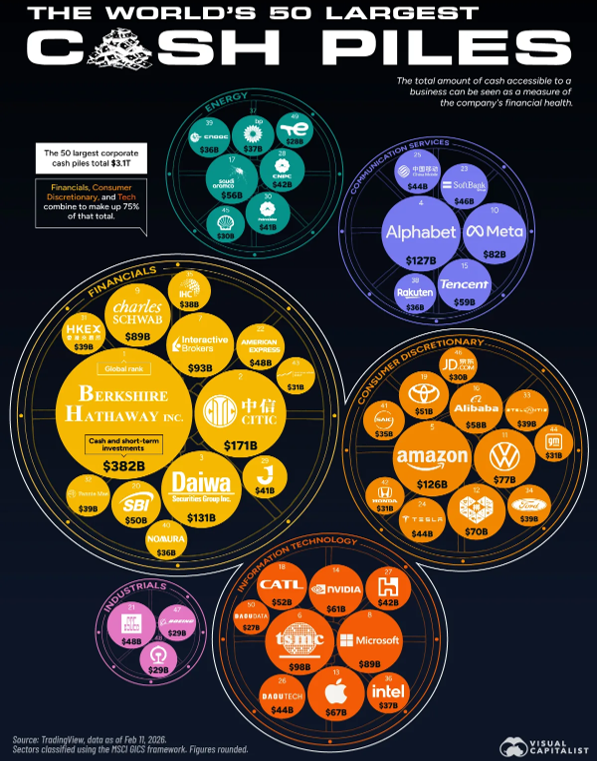
Source: Visual Capitalist
Sources
Alpine Macro, Anchor, Bloomberg, BNY Mellon, Charlie Bilello, Compound Advisors, Edmond De Rothschild, ETFMG, FactSet, Haver Analytics, JP Morgan, Julius Baer, LSEG, Morningstar, Morgan Stanley, Refinitive, RMB, Statista, Sygnia, Strategas, The Intelligent Investor, UBS.
Disclaimer
VEGA Asset Management has taken care that all information provided in this document is true and correct. VEGA Asset Management does not accept responsibility for any claim, liability, loss, expense, or damage. Any information herein is not intended nor does it constitute financial, tax, legal, investment, or other advice. VEGA Asset Management is an authorised Financial Service Provider with FSP number 776. Past performance is not necessarily an indication of future performance.