November 2026 Newsletter
November’s VEGA Asset Management newsletter reviews October’s global and South African markets, including rising oil prices, persistent inflation and the rotation out of technology shares. We report on the VEGA Global Strategic Fund, examine Palo Alto Networks and revisit Morgan Housel’s lessons on accepting the discomfort of investing.
Categories:
Date Posted:
November 10, 2026
Highlights of this month’s newsletter:
“Gold is money. Everything else is credit.”
― J.P. Morgan
Market overview: performance figures (%)
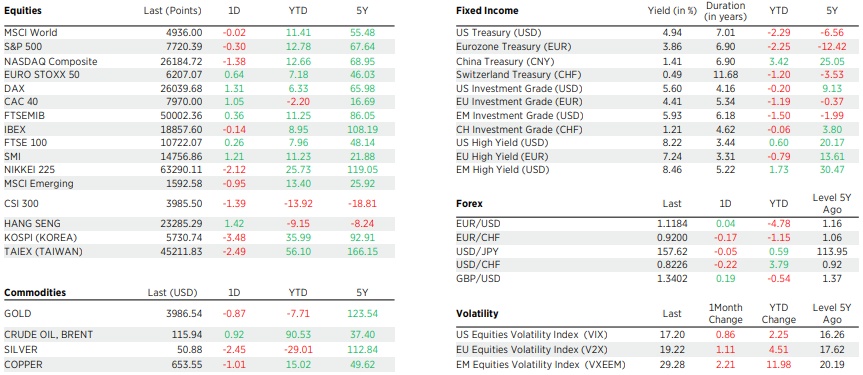
Source: Edmond de Rothschild, 30.10.2026
International market overview
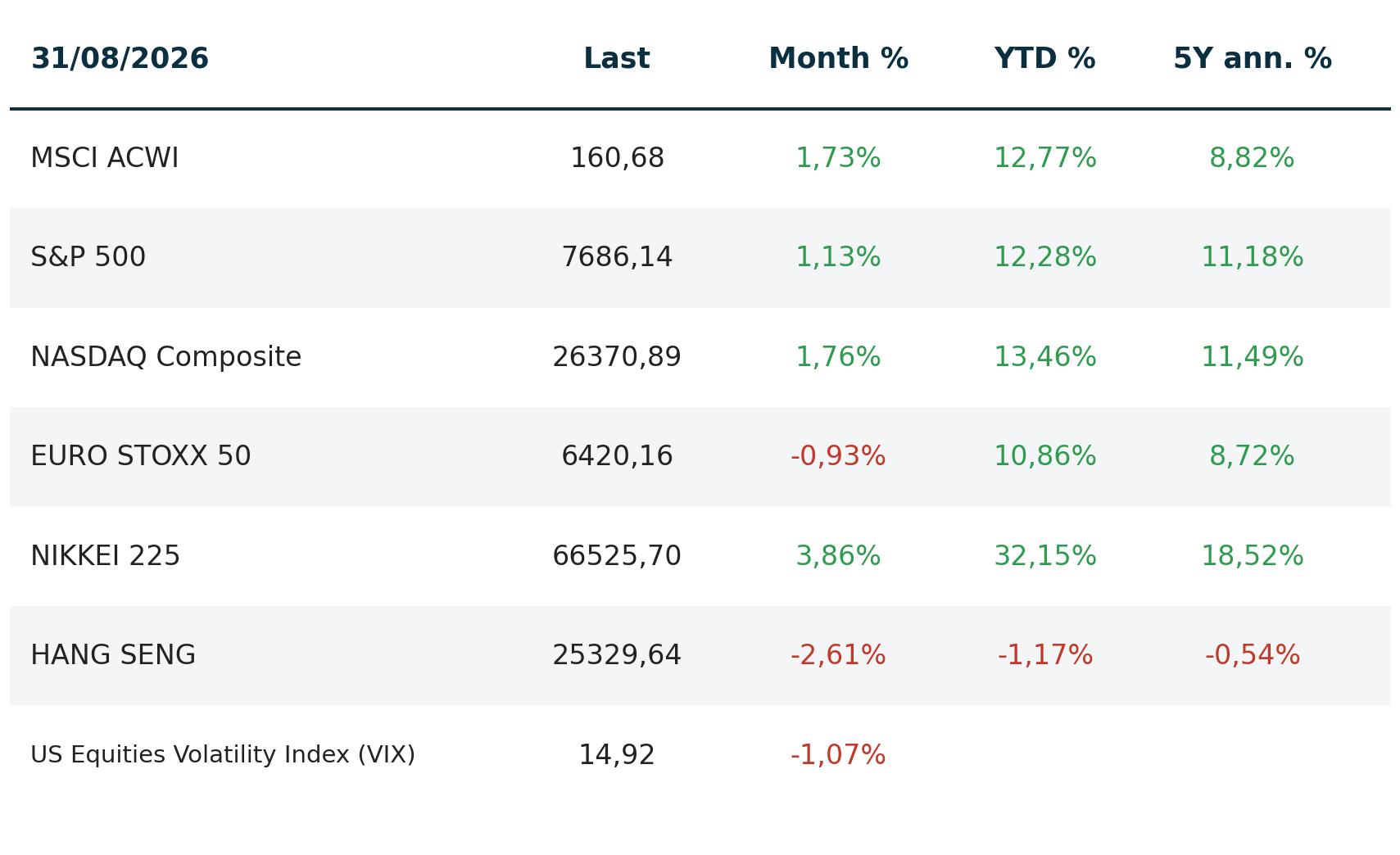
Source: Edmond de Rothschild
International market overview
October was supposed to be the quieter follow-up to a hawkish September. It was not. Oil climbed back to six-month highs as Israel turned up the pressure ahead of the US midterms, inflation surprised higher on both sides of the Atlantic, French bonds came under attack, and a debt scare at a handful of AI infrastructure firms set off a sharp rotation out of technology shares. Even so, the S&P 500 set a new record early in the month and the broader market took most of these shocks in its stride. Below we look at what drove markets in October and what it means for the months ahead.
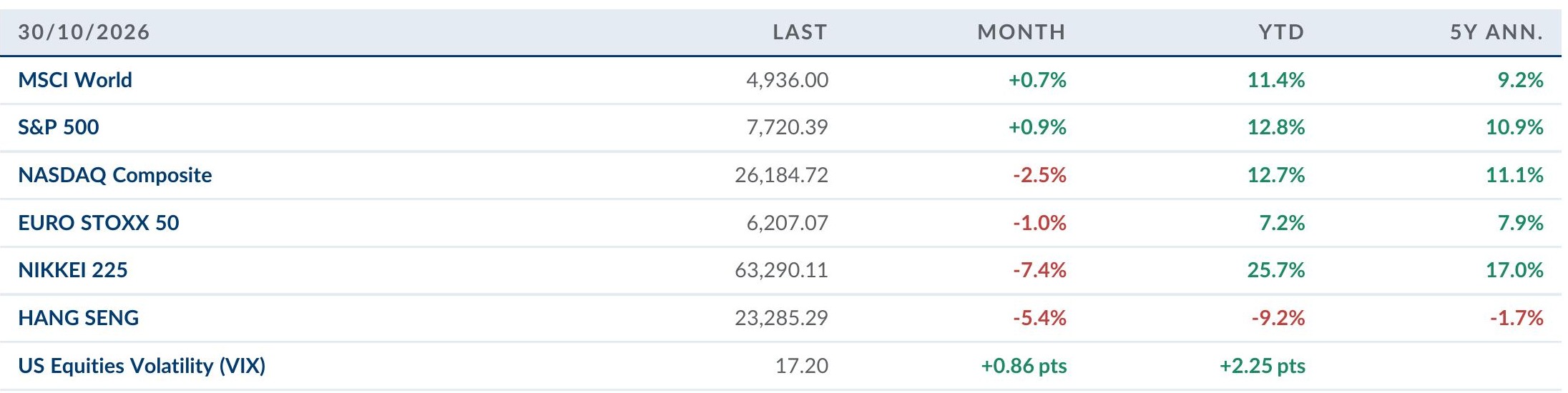
Source: Edmond de Rothschild
Central banks: a pause, not a pivot
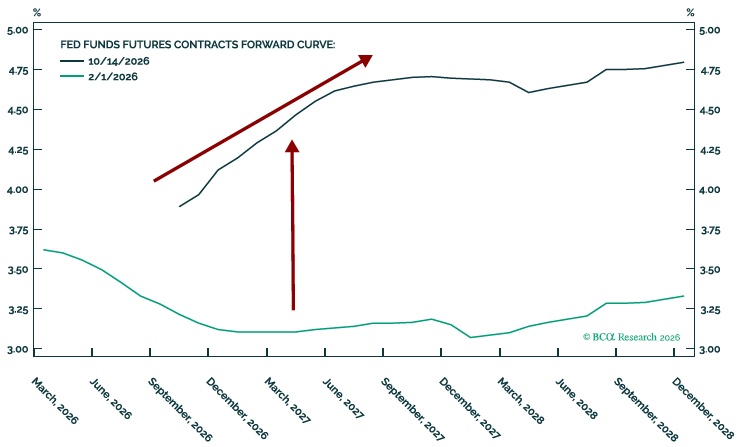
After September’s rate hike, the US Federal Reserve was widely expected to hold rates at 3.75–4.00% at its 28 October meeting. The odds of a second straight hike fell from about 37% at the end of September to roughly 5%, helped by weak US job creation (only 29,000 jobs in September) and cautious comments from Fed Chair Kevin Warsh. The bigger picture has not changed: markets now price about 70bps of further Fed hikes over the next 12 months, compared with nearly the same amount of cuts expected in January (Graph 1).
The rest of the developed world is on the same path. The Bank of England is expected to hike in November after UK inflation jumped to 3.5%, and the Bank of Japan, which raised rates to 1.25% in September, is expected to move again in December. The European Central Bank (ECB) is in a harder spot: inflation is high, but so is the stress in French bonds.
Graph 1: Markets have shifted from pricing cuts to pricing hikes
Source: BCA Research 2026
Inflation refuses to cool
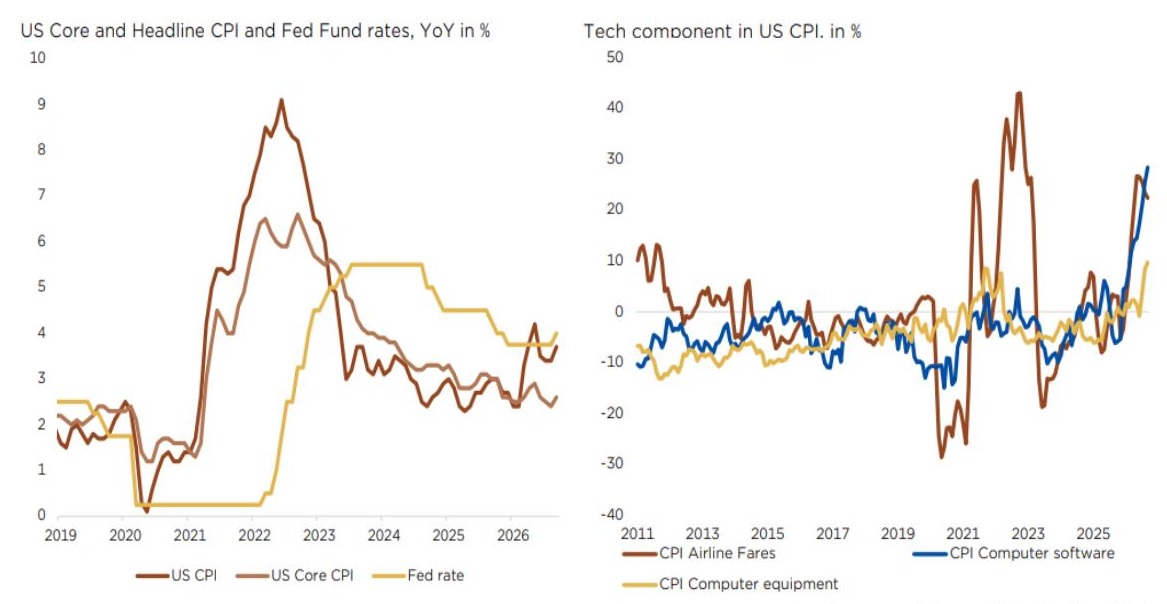
US consumer inflation rose to 3.7% in September, its highest level since April, and core inflation climbed to 2.6% (Graph 2). Eurozone inflation was confirmed at 3.8%. Much of this is still an energy story, but higher US software and computer prices suggest that the AI build-out itself is now adding to inflation.
Bond markets swung sharply. The US 10-year Treasury yield touched 5.33% after the inflation report, then fell back below 5% as investors sought safety during the tech sell-off. US mortgage rates have climbed to 7.4% from 6.2% in January.
Graph 2: US CPI and core CPI
Source: Edmond de Rothschild
France in the bond market’s sights
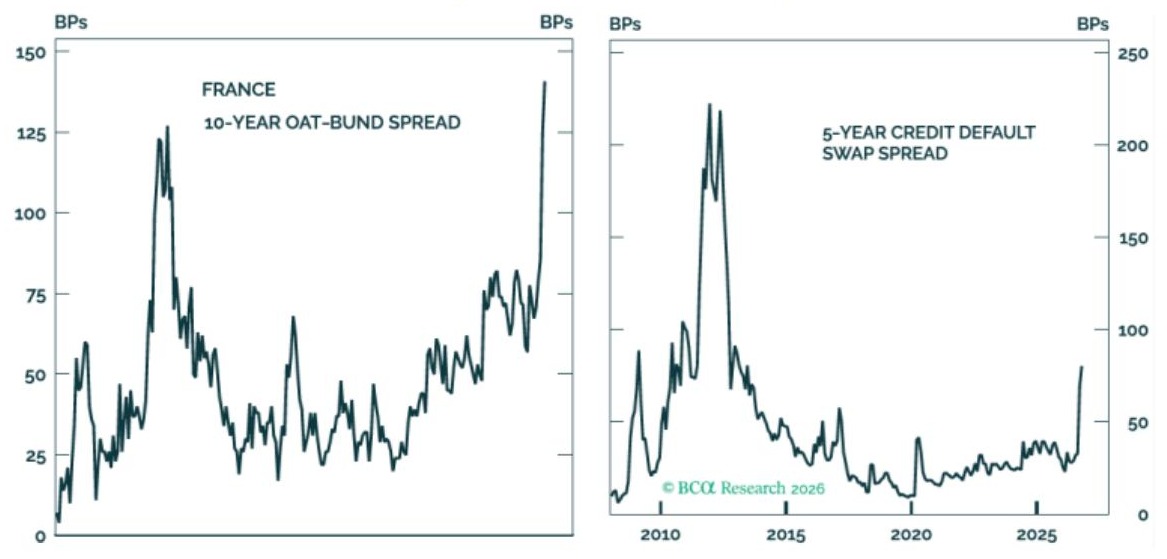
France’s 10-year yield reached 4.95%, the highest since 2002, and its spread over German yields widened to nearly 1.7 percentage points, the widest since the 2011 euro crisis (Graph 3). Cost-of-living protests turned into riots on 17 October, adding a political crisis to a fiscal one, and Moody’s kept France on a negative outlook. Spain heads to a snap election on 29 November. Our research partners at BCA warn that the ECB is unlikely to step in until a full-blown crisis is under way.
Graph 3: French bond spread over Germany
Source: BCA Research 2026
Oil: an “October surprise”
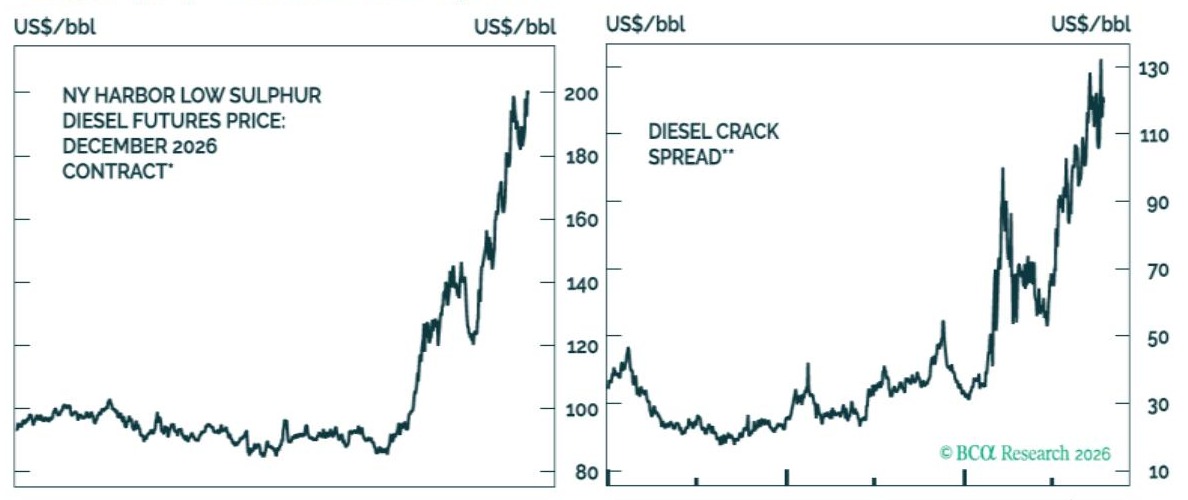
Energy was again the main pressure point. A G7 plan to release 100 million barrels from emergency reserves briefly pulled Brent crude down to around $102 per barrel early in the month. Then Iran stepped up attacks on tankers in the Strait of Hormuz, targeting 18 vessels on 12 October, the most since the war began, and Iran-backed Houthi rebels twice struck Riyadh’s main airport. Our view is that Tehran wants to keep fuel prices high until the 3 November midterms to weaken US resolve. Brent settled at $116.72 on 23 October, a six-month high (Graph 4), while diesel near $200 per barrel is feeding directly into transport and food costs.
Graph 4: Oil and diesel prices
Source: BCA Research 2026
AI: a debt scare, not a bust
Mid-month, the AI trade faced its toughest test yet. CoreWeave, a heavily indebted “neocloud” that rents computing power to AI developers, fell 25% in a week and its bonds dropped to 78 cents on the dollar. The Philadelphia semiconductor index (SOX) fell 12% in October, South Korea’s KOSPI entered a bear market and Japan’s Nikkei was down about 7% for the month by late October. Meta then fell 7% in a day despite strong results, after raising its capital spending guidance to as much as $145 billion.
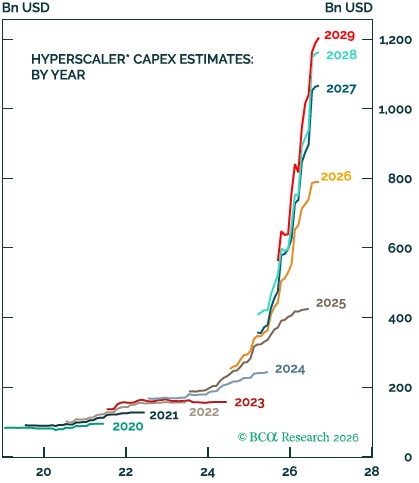
We see this as a rotation rather than a collapse. The five largest cloud companies plan to spend about $1.1 trillion in 2027, 2,5 times SA’s GDP (Graph 5), and unlike the neoclouds, fund most of it from strong cash flows. As investors moved out of tech, the equal-weighted S&P 500 rose, and US technology earnings are still expected to grow about 66% year on year this quarter.
Graph 5: Hyperscalers set to spend $1.1 trillion in 2027
Source: BCA Research 2026
Europe quietly holds up
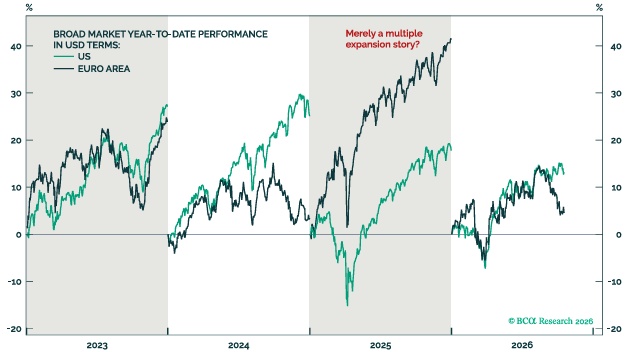
While Asia struggled, European shares held firm. They are less exposed to AI, and European bank profits rose 24% year on year in the latest quarter. Europe has outperformed the US by almost 12% since January 2025, despite an energy crisis and a US-led AI boom (Graph 6). European banks, telecoms, utilities and industrials are attractive sectors, although the French election may offer a better entry point.
Graph 6: Europe vs US since January 2025
Source: BCA Research 2026
Looking ahead: the midterms
Betting markets give the Democrats a more than 90% chance of winning the House of Representatives on 3 November, and better than 60% odds in the Senate. Markets need not fear this: historically, an opposition-controlled Congress has delivered the best 12-month stock returns. The larger risk is geopolitical, as President Trump may take a harder line on Iran once the election is behind him.
Our view: Stay invested, focus on quality
October showed that markets are increasingly selective. Investors are no longer rewarding every company linked to AI: they are punishing heavy debt and rewarding strong balance sheets. Higher-for-longer interest rates, oil above $110 and political strain in Europe all argue for discipline rather than retreat. Seasonally, the final months of the year have tended to be positive, and corporate earnings remain robust. We continue to favour high-quality businesses with strong cash flows, reasonable valuations and low debt, while staying diversified across regions, including Europe, and holding gold and real assets as protection while geopolitical risk stays high.
South African market overview

Source: Moneyweb, SARB
Local elections: what the polls say
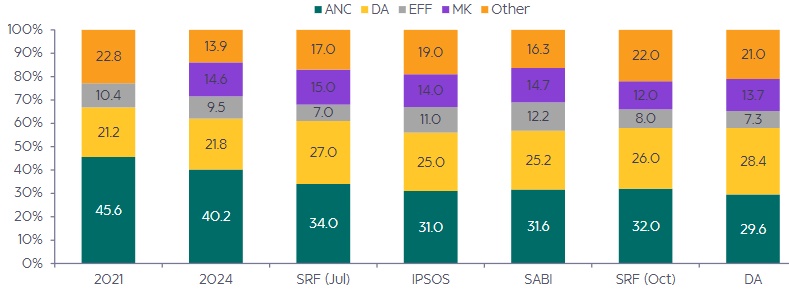
South Africans vote on 4 November. Graph 7 compares the actual results of the 2021 local and 2024 national elections with five recent opinion polls. Every poll has the ANC at 30% to 34%, well below the 40.2% it won in 2024, while MK holds 12% to 15% and the DA rises to 25% to 28%. MK should be the largest party in eThekwini and the DA could lead Johannesburg, Tshwane and Ekurhuleni, but no party is near a majority. Smaller parties could decide who governs the metros, a risk for service delivery. The base case is that the GNU remains broadly stable.
Graph 7: National election results and polls
Source: IES, SRF, IPSOS, SABI, Democratic Alliance, RMB Global Markets Research
MTBPS: fiscal discipline holds, with a short fuel levy cut
The 21 October Medium-Term Budget Policy Statement kept consolidation on track but cut 2026 growth to 1.2% from 1.6%. Gross debt peaked at 78.4% of GDP in 2025/26, and the main budget deficit narrows to 3.7% of GDP in 2026/27. From 4 November to 1 December, the fuel levy falls by R3.00 a litre on diesel and R1.50 on petrol, then tapers out by early January. This lowers the near-term inflation peak, but fuel inflation is likely to pick up again in early 2027.
Petrol hits a record R30.25 a litre
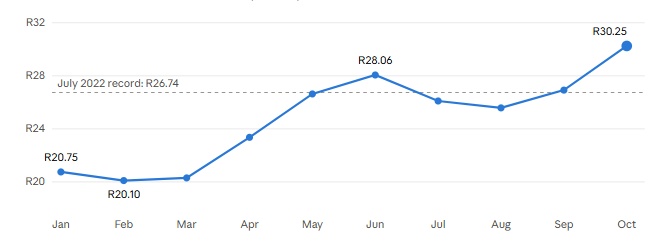
Inland 95 petrol rose R3.33 a litre on 7 October to a record R30.25, about R9.50 more than in January (Graph 8), and diesel reached a record R33.29. Brent has climbed from about $66 in early February, before the strikes on Iran, to above $116 on 30 October. Because South Africa imports most of its fuel already refined, product costs have risen faster than crude.
Graph 8: Inland 95 petrol price (R/litre)
Source: Trading Economics
JSE and rand: a choppy month ends slightly higher
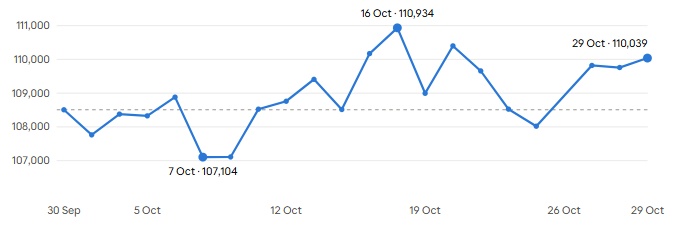
The JSE All Share rose 1.4% in October to 110,039 (Graph 9), after touching a 52-week low of 106,047 on 7 October as Brent moved above $100. It is still about 15% below its 2 March peak. The rand weakened to R16.69 to the dollar on 1 October, then held between R16.37 and R16.65. The move reflected dollar strength: against the euro, the rand was almost unchanged.
Graph 9: JSE All Share (1 month)
Source: Investing.com
El Niño puts food inflation at risk in 2027
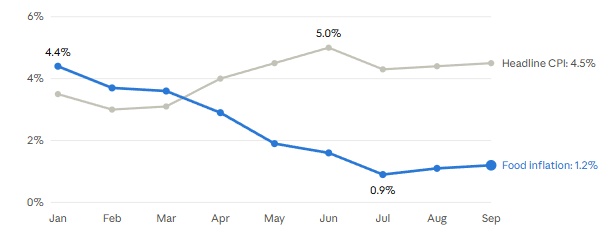
Food inflation was 1.2% in September, well below headline CPI of 4.5% (Graph 10), and a record 17.4 million tonne maize crop provides a cushion. The risk is the 2026/27 summer crop: the El Niño that formed in June is regarded as the most intense on record, and farmers plan to plant less maize. Higher food prices would likely reach consumers in late 2027, just as fuel levy relief unwinds.
Graph 10: Food inflation vs headline CPI
Source: Stats SA
VEGA Global Strategic Fund Update
October was a challenging month for the VEGA Global Strategic Fund. Over the month, the fund declined 3,5% while the MSCI All Country World Index, our reference benchmark, declined 1,3% in USD terms. Despite the short-term setback, we remain focused on the long-term opportunities within the portfolio and committed to our investment approach.
Graph 11: Total return in USD*
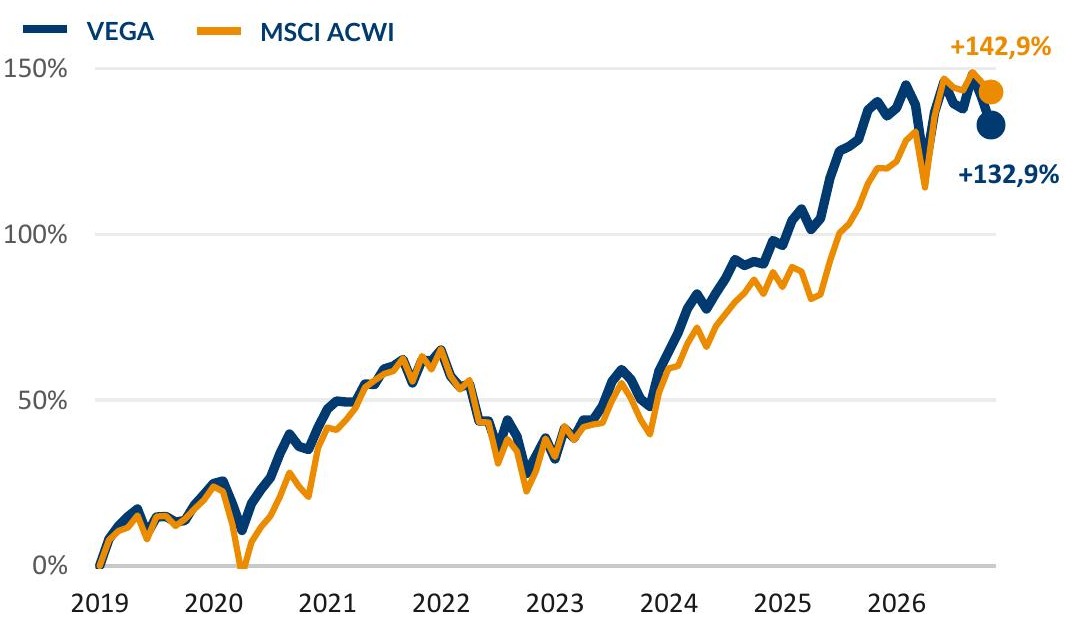
* The VEGA Global Strategic Fund launched in its current structure on 3 February 2025. Performance figures prior to this date represent the same investment strategy and process in an unregulated structure managed by Storm Capital Limited and VEGA Asset Management in the VEGA Global Equity Segregated Swissquote accounts.
Top performers
Lockheed Martin Corporation (LMT), +22,3%. Lockheed Martin returned 22,3% in October and added 38,6 basis points, the largest contribution in the fund. Third-quarter revenue rose 11,3% to nearly $21 billion and management raised its outlook for 2026. A new 10-year F-35 production contract structure gives better visibility on the company’s most important programme. Lockheed Martin’s fair value estimate is raised to $680, and at $637 the shares trade about 6% below it.
ConocoPhillips (COP), +18,9%. ConocoPhillips returned 18,9% and added 32,8 basis points. Its LNG portfolio, including stakes in Qatar’s North Field expansions and Port Arthur LNG on the US Gulf Coast, has become more valuable since the Iran war took Qatari supply offline. Second-quarter EBITDA beat consensus by 8%.
Chevron Corporation (CVX), +13,5%. Chevron returned 13,5% and added 32,2 basis points. Third-quarter earnings beat expectations as strong refining margins offset slightly lower oil prices, showing the value of its integrated model. Chevron bought back $2,5 billion of shares in the quarter and plans to double production in Venezuela to about 600 thousand barrels a day by 2031. Up 58% this year, the shares trade at $236, about 17% above the $202 fair value estimate.
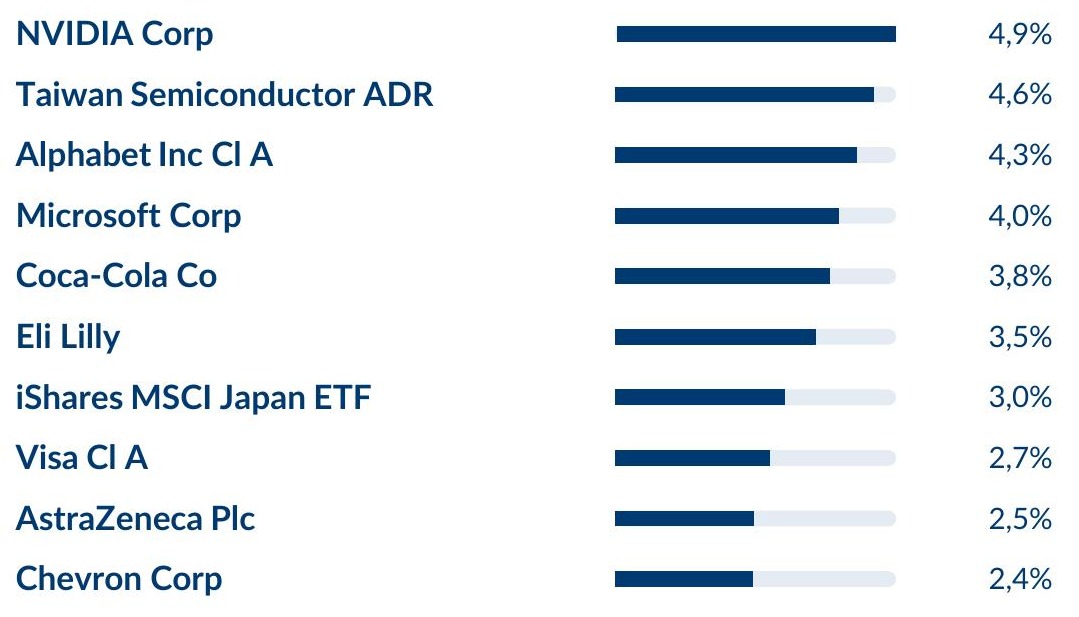
Top 10 Holdings
Annualised returns (%)

Portfolio strategy
In the wake of heightened market volatility, our stance has been to remain disciplined and avoid reactive portfolio shifts. History consistently shows that impulsive responses to short-term political noise often result in suboptimal investment outcomes.
Instead, we have used this environment to evaluate high-quality businesses that were indiscriminately sold off despite their strong long-term fundamentals. Periods of uncertainty can create attractive entry points into quality companies at compelling valuations, and we continue to focus on identifying these opportunities with a long-term perspective.
The portfolio remains invested in leading global businesses with durable competitive advantages, particularly those delivering high returns on capital and robust free cash flow generation. Dividend policies are not a central consideration in our selection process, as we generally favor companies that reinvest earnings to drive future growth.
We also resist the temptation to follow short-lived market trends or fashionable investment narratives, as preserving portfolio quality takes precedence over chasing momentum.
Top Pick Of The Month: Palo Alto Networks (PANW)
Cybersecurity| Platform Leader | NASDAQ: PANW

Investment Case
Enterprises run 60–80 separate security tools and want to cut that to 15–20, as cloud migration, hybrid work and AI multiply the entry points attackers can exploit. Breaches also cost more, with regulatory fines and reputational damage on top of the commercial loss. Palo Alto sells network, cloud, identity and security-operations protection on shared platforms, so a client can replace several point vendors with one and avoid data silos between tools.
Every Fortune 100 company and more than three-quarters of the Global 2000 are customers, and over half of the Global 2000 use all three core platforms. Revenue is forecast to grow 18% a year over the next five years, with gross margins rising from the low 70s to the high 70s as software becomes a larger share of sales.
Economic Moat
Switching costs are high: replacing an embedded security vendor means retraining staff and a period of higher exposure. Data from every client also trains the AI that detects new threats, improving protection for all.
Business Strategy Outlook
- Network security: Strata firewalls come in hardware and software form, and Palo Alto was an early leader in SASE.
- Cloud security: Prisma protects workloads running in the cloud and is cross-sold to existing firewall clients.
- Security operations: Cortex covers endpoints and automated threat response, with agentic AI adding demand.
- Identity: CyberArk, sold as the Idira platform, is being cross-sold into the large installed base.
Capital Allocation
CEO Nikesh Arora, formerly president and COO of SoftBank and a senior Google executive, has led the firm since 2018. Acquisitions and in-house development built the Prisma and Cortex platforms, taking Palo Alto beyond its core firewall market. The $20bn CyberArk purchase is now cross-selling well into the installed base. No dividend is paid or planned; cash goes back into growth across network, cloud and security operations.
Financial Strength
Palo Alto ended fiscal 2026 with about $3bn in cash and liquid investments against $1.8bn of debt. GAAP operating profit returned in fiscal 2023 for the first time in a decade, and free cash flow has been positive every year since the IPO. Operating margins should widen as research and sales spending falls as a share of a growing revenue base.
Key Risks
- Valuation: The share trades on a premium multiple, so any slowdown in growth could weigh on the price.
- Cloud vendors: Large public clouds offer their own security tools, which could limit growth.
- Rival platforms: Competitors also sell platforms, which entrenches them with clients and makes them hard to displace.
- Integration: Absorbing CyberArk adds execution risk that could slow growth elsewhere in the business.
- Fast-moving market: Smaller upstarts could win key modules, and misreading demand could mean overpaying for acquisitions.
Source: Palo Alto Networks, independent research. Price as at 27.10.2026. Past performance does not guarantee future results.
Same as Ever – Chapter 15: It’s Supposed to Be Hard
Morgan Housel opens Chapter 15 with a scene from Lawrence of Arabia. T.E. Lawrence snuffs out a match with his bare fingers, and when a fellow officer tries it and yelps, he explains that the trick is not minding that it hurts. Housel’s point is that almost everything worth having carries a price, and the price is rarely paid in money. It is paid in effort, boredom, uncertainty, setbacks and hassle. People who do well tend to identify that price early and accept it, rather than spend their energy looking for a way around it.
The danger lies in assuming there must be a shortcut. Charlie Munger put the alternative simply: the safest way to try to get what you want is to try to deserve what you want. Shortcuts are tempting because they promise the reward without the cost. Usually they only hide the cost, or defer it until it arrives with interest. When something worthwhile looks easy, it is worth asking what price has not yet been paid.
Difficulty is not proof that something is failing. Frustration, imperfection and delay are part of the overhead of doing anything worthwhile. Housel argues that a useful skill is judging the optimal amount of hassle to put up with: enough to make progress and keep relationships intact, without fighting every inconvenience.
The price of a shortcut
History’s clearest warning is the Donner Party. In 1846 a group of families heading for California left the established trail to follow the Hastings Cutoff, a new route promoted as a faster way west. It had barely been tested. The shortcut cost them weeks in rough terrain, and by the time they reached the Sierra Nevada, snow had closed the passes. Nearly half of the party died that winter.
The lesson is not that new routes are always wrong. It is that a promise to skip the hard part deserves the most scrutiny, precisely because it is so appealing. The established trail was slow and exhausting, but thousands had walked it and survived. Its difficulty was the price of reliability, and most of those who paid it arrived safely.
Investing works the same way. The returns from shares are not free. They are paid for with volatility, long stretches of disappointment and the discomfort of watching a portfolio fall in value. Investors who see that as a fee rather than a fine are far more likely to stay the course. Every attempt to remove that discomfort has a cost of its own. Trying to time the market to avoid the falls usually means missing the recoveries, and products that promise equity returns without equity risk tend to hide fees, leverage or illiquidity.
What this means for investors
The market’s ups and downs are not a sign that something is broken. They are the price of admission for long-term growth. A plan built on the expectation that investing should feel smooth will be abandoned at the first sharp fall, while a plan that expects discomfort can survive it. Setting that expectation at the start is one of the most valuable things an adviser can do.
For private clients, the practical lesson is to decide in advance which price you are willing to pay. Accept that a growth portfolio will have years when it falls, and hold enough cash that you are never forced to sell in one. Be sceptical of anything that promises high returns with little risk or effort, and stick with the dull habits that work: regular contributions, diversification and patience. The trick, as Lawrence said, is not minding that it hurts.
Graph of the month – The World’s Oil Reserves by Region
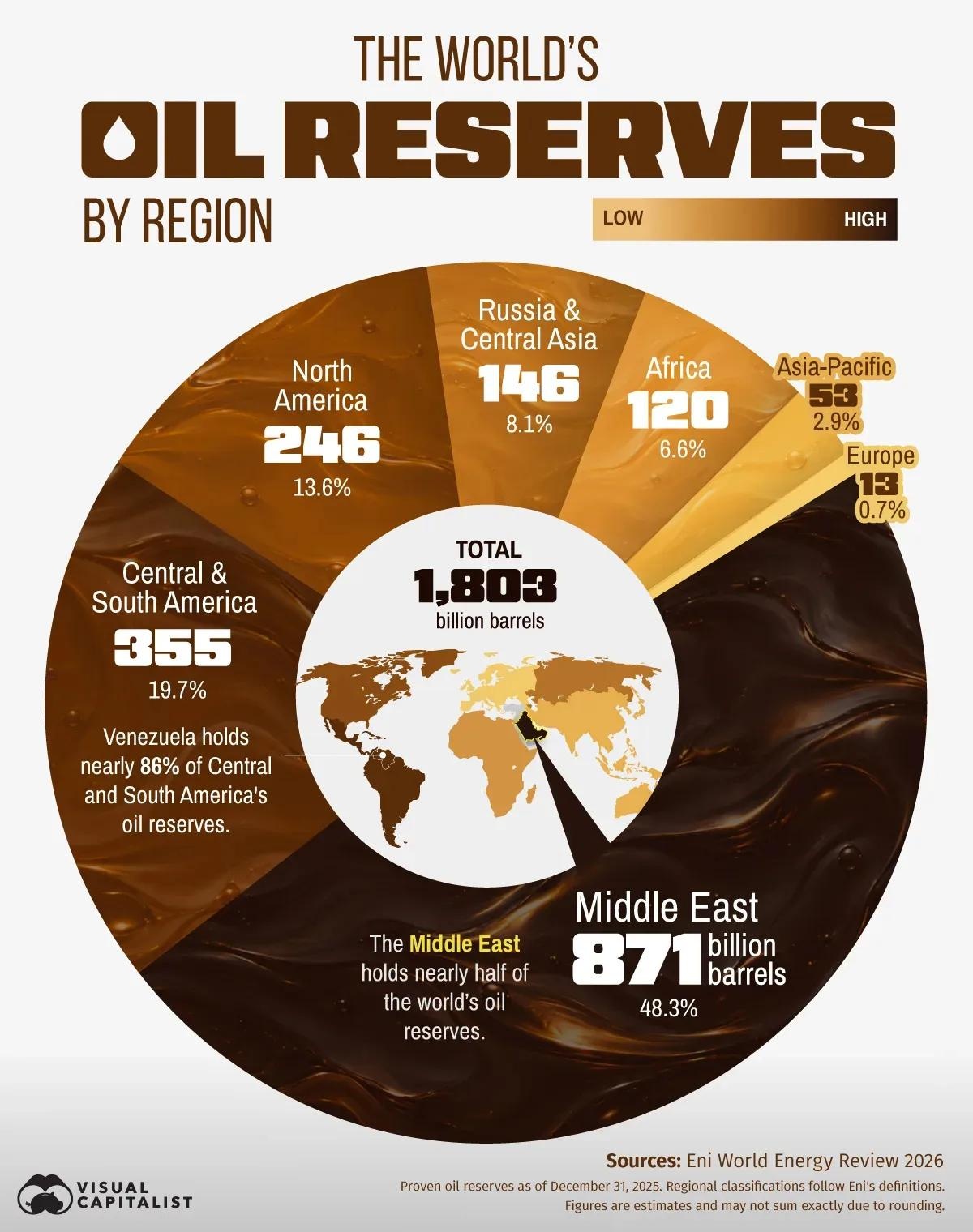
Source: Visual Capitalist
Sources
Alpine Macro, Anchor, Barchart, Bloomberg, BNY Mellon, Business Day, BusinessTech, Central Energy Fund, Charlie Bilello, Citi, CNBC, Compound Advisors, DigitFMS, Edmond De Rothschild, ETFMG, EWN, FactSet, Finimize, FXStreet, Haver Analytics, Investing.com, InvestorIdeas, IOL, JP Morgan, Julius Baer, LSEG, Moneyweb, Morgan Stanley, Morningstar, News24, Refinitiv, Reuters, RMB, SAnews, SARB, Société Générale, Statista, Statistics South Africa, Strategas, Sygnia, The Intelligent Investor, The South African, TimesLIVE, Trading Economics, TreasuryONE, UBS, Vutivi Business, Wise.
Disclaimer
VEGA Asset Management has taken care that all information provided in this document is true and correct. VEGA Asset Management does not accept responsibility for any claim, liability, loss, expense, or damage. Any information herein is not intended nor does it constitute financial, tax, legal, investment, or other advice. VEGA Asset Management is an authorised Financial Service Provider with FSP number 776. Past performance is not necessarily an indication of future performance.